


Pipeline Planning with Drone LiDAR: A 280km Survey in Central Africa

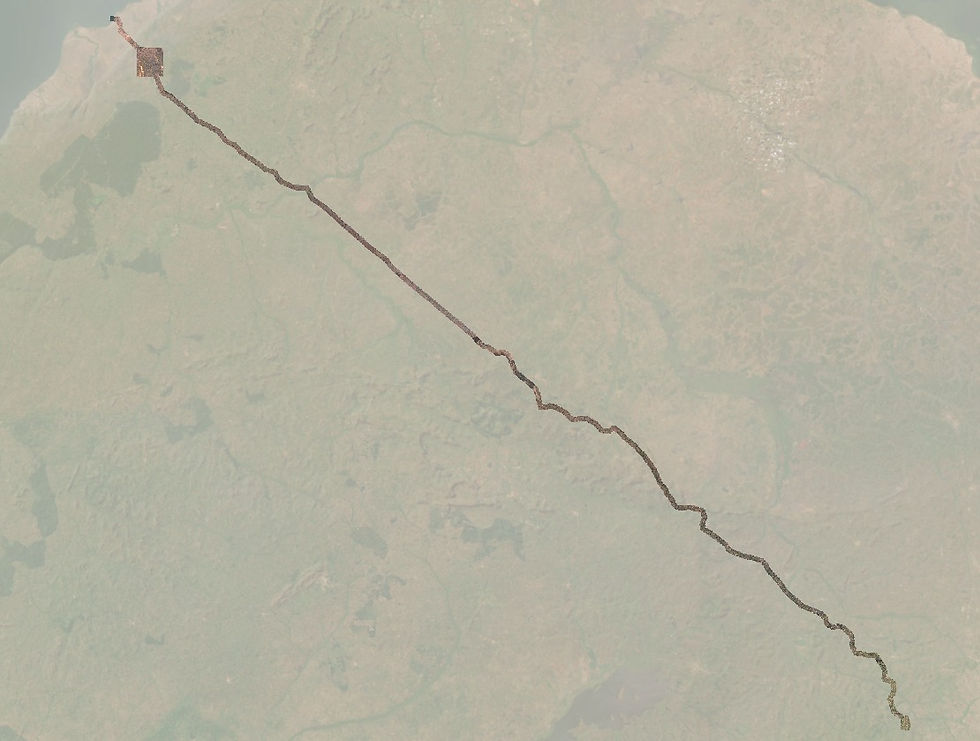
Planning a pipeline route across challenging terrain requires precise data and careful analysis. Recently, 3DroneMapping had the opportunity to work on a drone LiDAR aerial survey covering a 280km pipeline route in Central Africa. This project combined advanced drone technology with detailed ground control to deliver highly accurate terrain data. The results will help engineers design the most efficient and safe pipeline path, considering natural features and existing infrastructure.
Setting Up Ground Control for Accuracy
Before launching the drone flights, we established ground control points along the proposed pipeline route. These points were spaced every 1km and measured with an accuracy of 10mm. Ground control is essential because it provides fixed reference locations that ensure the aerial data aligns perfectly with real-world coordinates.
These benchmarks will not only support the survey but also serve as reference points during the pipeline construction phases. By having reliable ground control, engineers can track progress and maintain alignment with the planned route.

Using Long-Range VTOL Drone and LiDAR Technology
The survey employed a specialized long-range VTOL (Vertical Take-Off and Landing) drone equipped with a high-resolution LiDAR system. This setup allowed us to cover a wide corridor—1km wide along the entire 280km length—capturing detailed terrain data with a point density of 18 points per square meter.
The LiDAR system achieved an accuracy better than 50mm, which is impressive given the scale and complexity of the terrain. This level of precision is critical for pipeline construction, where even small errors can lead to costly adjustments or safety issues.
The VTOL drone’s ability to take off and land vertically made it ideal for the remote and varied landscapes of Central Africa, where traditional runway access is limited or nonexistent.

Flight Operations and Challenges
Completing the survey took six days of flight operations. The schedule was affected by poor weather conditions, including heavy rain and strong winds, which are common in the region. These delays required careful planning and flexibility to ensure data quality was not compromised.

Each flight covered a segment of the route, capturing overlapping LiDAR scans to create a seamless 3D model of the terrain. The data collected includes elevation changes, vegetation, water bodies, and man-made structures such as houses, roads, and bridges.

How Engineers Use the Data
Once processed, the LiDAR data provides a detailed digital terrain model (DTM) that engineers use to evaluate the best pipeline route. They analyze the terrain to avoid steep slopes, unstable ground, and environmentally sensitive areas. The data also helps identify existing infrastructure that the pipeline must cross or avoid.
By integrating this information, engineers can design a route that minimizes construction challenges and environmental impact. The precise measurements reduce the risk of unexpected obstacles during construction, saving time and costs.

Benefits of Drone LiDAR for Pipeline Construction in Africa
Using drone LiDAR for this survey brought several advantages:
High accuracy: The sub-50mm precision ensures reliable data for planning and construction.
Speed and coverage: The VTOL drone covered a vast area quickly compared to traditional ground surveys.
Access to remote areas: The drone operated in regions difficult to reach by vehicle.
Detailed terrain and infrastructure mapping: Capturing natural and man-made features supports better decision-making.
These benefits are especially valuable in Africa, where terrain can be challenging and infrastructure limited. Drone LiDAR helps overcome these obstacles efficiently.

Looking Ahead
The data from this survey will guide the pipeline construction team as they move forward. Ground control points will serve as benchmarks to monitor construction accuracy. The detailed terrain model will support ongoing planning and risk management.
This project demonstrates how combining drone LiDAR technology with careful ground control can deliver precise, actionable data for large-scale infrastructure projects in complex environments.
If you are involved in pipeline construction or infrastructure planning, consider how drone LiDAR surveys can improve your project outcomes. The technology offers a practical way to gather detailed terrain data quickly and accurately, even in remote or difficult locations.


